
Introduction
With a rumoured production budget of up to ₹4,000 crore for the two-part drama, the next Ramayana film is expected to become the most expensive film ever made in India.
The old story of the Ramayana has always been retold with significant social implications and profound legendary resonance. The risks are bigger than ever for Nitesh Tiwari’s impending two-part film remake, both in terms of production ambition and storyline. The movie aims to create an experience unlike anything seen before in Indian cinema by marrying blockbuster-level beauty with great storytelling.
Why the Budget Is So High
The film is being produced as a two-part saga. Early reports suggested a combined budget of nearly ₹1,600 crore, with approximately ₹900 crore allocated for Part 1 and ₹700 crore for Part 2.
But more recent disclosures by the producer suggest the full investment may soar to ₹4,000 crore, or roughly US $500 million, by the time both films are completed.
This huge increase reflects the team’s ambition to create a “global-level” cinematic experience—one that competes with international epics rather than just Indian blockbusters.
World-Class VFX and Technical Scale
The funding is mostly devoted to world-building, digital arts, and visual effects. DNEG, a well-known British-Indian company with several Academy Awards for Best Visual Effects, is reportedly handling the VFX.
The scope of the action scenes, the size of the sets, the costumes, and the digital resources for legendary kingdoms like Ayodhya and Lanka all significantly increase the expenses. The filmmakers are dedicated to making sure that every element, from beauty to detail, captures the legendary impact of the epic.
Using the same assets in different episodes
To optimise costs across two films, the makers plan to reuse many of the expensive assets (sets, CG assets, and costumes) created for Part 1 in Part 2. That’s one key reason why the second part’s budget is reportedly lower (₹700 crore) than the first part.
This reuse strategy makes sense given the epic’s scale—building a mythical world only once and then using it for both instalments.
What Previous Estimates Say—and How They Changed
Different figures have changed over time. The evolution of the budget estimates may be roughly timed as follows:
| Estimate (Time) | Reported Budget | Notes |
|---|---|---|
| Early (2024) | ~₹835 crore for Part 1 (~US $100 million) | This made “Ramayana” the single most expensive Indian film at that time. |
| Soon after | ~₹1,600 crore for both parts (₹900 cr + ₹700 cr) | Indicated as a franchise-wide budget excluding print & publicity. |
| Latest (2025) | ~₹4,000 crore (~US $500 million) | The official producer’s claim reflects expanded scope and global ambitions. |
Also read: Ramayana Movie: Release Date, Cast, Story & Review
This change shows a deliberate expansion of the project to meet international cinematic standards rather than just increases or rumors.
The fact that early costs are sometimes risky and grow as the size becomes more apparent, particularly for VFX-heavy epics, adds to how dynamic film productions are.
What This Means for Indian Cinema
New Benchmark for Budget & Ambition: If ₹4,000 crore holds, “Ramayana” will set an entirely new standard for how big Indian films can be. It’ll dwarf previous big-budget films like Kalki 2898 AD (₹600 crore), RRR, and Adipurush (each ₹550 crore).
Global Aspirations: The involvement of a top-tier VFX studio and a budget comparable to mid-level Hollywood films suggests the creators are targeting not just Indian audiences but a global one. If successful, this could encourage more Indian filmmakers to think internationally.
Risks & Rewards: With such a huge investment comes high stakes. The break-even point will be massive. But if “Ramayana” delivers—in visuals, storytelling, and box office—it could change how Indian epics are conceived and financed.
Why the Budget Figures Still Vary
Despite multiple reports, exact budget numbers for “Ramayana” remain fluid. Reasons include:
Evolving Scope: As VFX requirements, set designs, and creative ambitions increased, so did the cost. What began as a “big budget by Indian standards” gradually turned into a “global-scale budget.”
Producer Statements vs. Industry Estimates: Some figures come from media reports, others from insiders, and some from the producer himself. Each tends to reflect a different level of certainty (initial estimate vs. final investment).
Inclusion/Exclusion of Costs: Some reports (like ₹1,600 crore) refer only to production costs—excluding marketing, distribution, dubbing, and post-production overheads—while higher numbers attempt to account for the entire investment.
Final Thoughts: What to Watch Out For
Because the film is still in production and “epic scale + VFX + global ambitions” tends to expand budgets, it’s wise to treat even ₹4,000 crore as a projected or upper-limit estimate, not an absolute final cost—unless confirmed after release.
If “Ramayana” lives up to its promise, it could usher in a new era of Indian mythological and epic films—big budgets, global reach, and cinematic ambition. But with great ambition comes great responsibility: it needs to deliver on storytelling, execution, and audience experience.
FAQs About Ramayana’s Record-Breaking Budget
1. What is the official budget of the new Ramayana movie?
A. The upcoming Ramayana film is reported to have a massive budget ranging between ₹1,600 crore and ₹4,000 crore, depending on the report. The higher figure reflects the full investment planned across two parts, making it India’s most expensive film.
2. Why is Ramayana considered the costliest Indian film ever?
A. Ramayana’s huge budget comes from its advanced VFX work, large-scale sets, world-building, star cast, and global-level production design. These factors combined make it more expensive than films like RRR, Adipurush, or Kalki 2898 AD.
3. Who is directing the Ramayana film?
A. The movie is directed by Nitesh Tiwari, known for films like Dangal and Chhichhore. His focus on realistic storytelling and large-scale execution is a major reason for the project’s growing scope.
4. Which actors are part of the Ramayana cast?
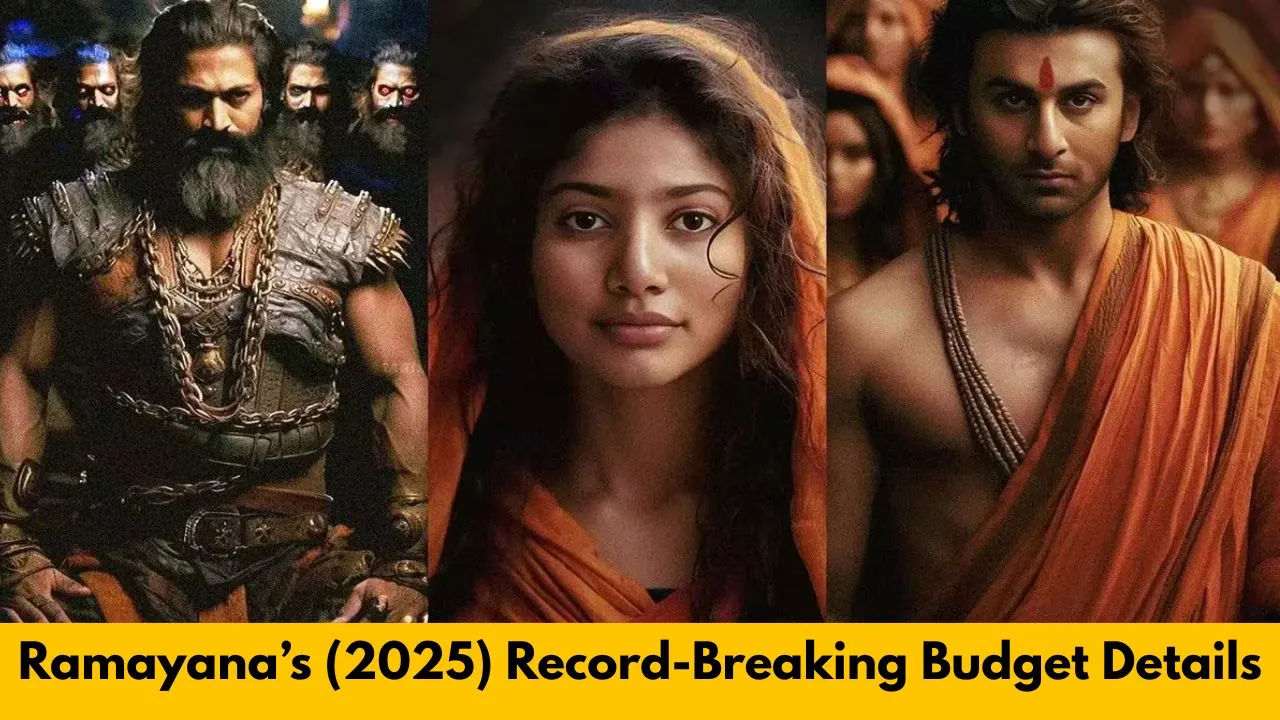
A. Reportedly, Ranbir Kapoor plays Lord Ram, Sai Pallavi plays Sita, and Yash appears as Ravana. The supporting cast includes actors for key roles like Lakshman, Hanuman, and Vibhishan.
5. Why does the budget vary in different reports?
A. Different media outlets include or exclude costs like VFX, marketing, and multi-part expenses. Early estimates were lower, and the budget expanded as the project grew in size and ambition.
6. How many parts will the Ramayana movie have?
A. The film is planned as a two-part epic, with Part 1 featuring the core storyline and world-building and Part 2 covering the later chapters of the epic.
7. Which VFX team is working on Ramayana?
A. Top-tier studio DNEG, known for award-winning Hollywood films, is reportedly handling the visual effects, contributing significantly to the premium cost.
8. When will Ramayana Part 1 release?
A. The makers have not officially announced a final release date, but production timelines suggest a release expected after 2025, depending on VFX completion.
9. How does Ramayana’s budget compare to other big films?
A. Ramayana’s estimated ₹4,000 crore investment is higher than Kalki 2898 AD (₹600 crore), RRR (₹550 crore), Brahmastra (₹410 crore), and Adipurush (₹550 crore).
10. Will Ramayana release globally?
A. Yes. With Hollywood-grade VFX and a global marketing plan, the film is expected to release in multiple languages across international markets.